

Fig trees are one of the many wonderful plants that are both edible and medicinal, with many benefits and uses. So if you’re thinking of growing them, that’s a good thing and this article on how to grow figs indoors or outside, should help you get off to a good start with this wonderful plant ally.
You’ve probably eaten a Fig Newton cookie..? Love ’em or hate ’em, they’re a far cry from the taste of fresh figs. If you’ve ever plucked a perfectly ripe, soft fresh fig fruit from the branch and sank your teeth into the pink, seedy, nectar-sweet flesh, you’ll be hooked!
If you enjoy figs, might as well grow a fig tree or two. Fig trees are one of the easiest fruit trees to grow indoors or out.
Figs are one of the easiest fruit trees to grow.
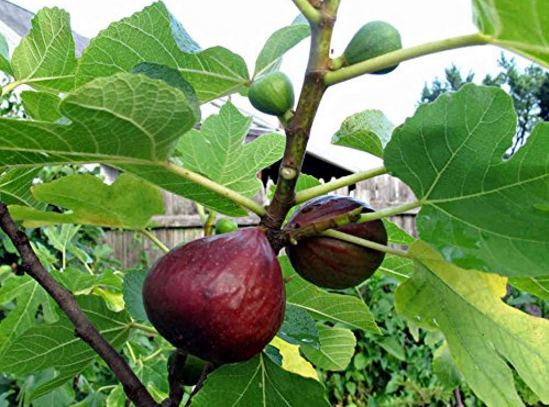
Fresh figs are a luxury fruit.
Dried Figs vs. Fresh Figs
You have probably seen and eaten dried figs. The “black” and “white” varieties are the most commonly seen dried figs sold in grocery stores. However, it’s rare to find a box of fresh figs, unless you’re in one of the few states that grow them.
Fresh figs simply don’t stay fresh for very long, which means they don’t travel well enough to export very far, so most grocery stores don’t even bother stocking them.

Fig Varieties
Five popular varieties of figs include:
- Brown Turkey Figs
- San Piero Figs
- Celeste Figs
- Bethlehem Black Figs
- Kadota Figs
There are other varieties, such as the Panache Tiger Fig, that are considered specialty crops that fetch a higher price at market. That’s because Tiger Figs tend to produce smaller crops and are a bit more difficult to grow than the most common commercial varieties.[1]https://www.burpee.com/fruit/figs/fig-panache-tiger-stripe-prod100091.html
Dwarf Fruit Trees
How big do dwarf fig trees grow? Dwarf trees naturally mature between 8-10 feet tall and wide. If you’re going to grow figs in containers and indoors part of the year, you’ll want to be sure to order a dwarf variety fig plant.[2]https://www.starkbros.com/growing-guide/article/fruit-tree-sizes
Speaking of dwarf fruit trees… we love growing the dwarf Meyer lemon trees, that bear fruit indoors in winter and outdoors in summer.
Fig Trees for Sale
Buy Local
We prefer to source plants from local nurseries first. This not only support local businesses, but you get the opportunity to get to know local business owners who become friends and a ready source of information and aid in your growing ventures.
Often, your local nursery or garden center will be glad to special order plants for you if they don’t have what you’re looking for. If something goes wrong and a plant gets sick, they’re often only a phone call away toward offering immediate troubleshooting advice.
If a plant does die, and you’ve done all the right things, local nurseries will often replace it for free or discounted within a reasonable warranty period.
Ordering Plants Online
We often like to try new, lesser known and exotic plants, such as tromboncino squash, red Kuri squash, cucamelons, and pumpkin-on-a-stick. For those, you may need to order online. Here are some of our go-to online plant and seed companies.
- Amazon can be a good resource of all kinds of plants. Just heed the reviews before ordering.
- Baker’s Creek, RareSeeds.com
- EdibleLandscaping.com is a great resource for all kinds of plants and information. Visit them in Virginia, or order online.[3]https://ediblelandscaping.com/buyPlants.php
- Fast Growing Trees
- Stark Bros Dwarf Figs
- See our list of 80+ Seed Companies
Propagating Figs From Cuttings
The best part about growing your own fig trees is that they are very easy to start just from cuttings. All you need to do is cut a 4-8 inch piece of branch off a thriving tree. It doesn’t matter if there are a few leaves or none.
How to Grow a Fig Tree from Cuttings – Part 1
How to Grow a Fig Tree from a Cutting – Part 2
Air Propagation
A new technique demonstrated by Mike of Mike’s Backyard Nursery.
Rooting Fig Tree Cuttings in Soil
Place fig cutting into a small pot of healthy moist soil, compost or potting soil. You can use rooting hormone if you like but it’s not essential. However, some — like Ross Raddi — favor parafilm for the cuttings.
If you stick the fig cutting in soil, keep the soil moist for 2-4 weeks until roots form and leaves begin to grow. Transplant as needed, by upsizing to a new pot each year.
Propagating Figs in Water
Alternately, you can simply place the cutting in a jar of water in a bright window. You should see roots beginning to sprout after a week or two, and you can then pot them.
Once they begin budding and leafing out, you have the option to plant it in their permanent home in the ground, or keep it potted.
Propagating Figs In Summer
The baby you have planted will be an exact clone of the parent fig, so you will want to grow several types or varieties in order to expand your market.
How to Grow Figs in a Pot
You can plant smart from the start by planting your fig trees in rolling pots. Rolling pots and plant dollies really help for moving heavier plants around indoors and out. Indoors you may want to move them a bit to chase the sun as well as the functionality of being able to more easily clean around and under them.
Be sure to invest in a plant dolly with heavy duty castors like this plant dolly good for up to 500 lbs. It’s reasonably priced and ships for free if you have Amazon Prime.
Plant the fig tree in potting mix and for best results, top with bark mulch to help retain moisture and create your own rich soil over time. For container grown figs, it’s best to add a nitrogen-rich fertilizer every four weeks or so and provide ample sunlight.
Your fig tree will be happier outside in summer, and at a southern facing sunny window indoors in winter.
Alternately, you may use supplementary lighting, such as these indoor LED grow lights.
“I’m amazed that my fig tree would set fruit in February indoors. I never put it out for the summer and it had a long winter of low light but it’s been fruiting for a few years now and it always starts to set fruit in February. I think Figs are a great plant for growing in pots and mine grows fine indoors all years.”
~Pat Porter, gardener, homesteader in Washington State
How To Grow Figs in a Cold Climate
Cold Hardy Fig Trees
- Chicago Hardy Fig (zones 5-10, may die back in winter and regrow in spring)
- Brown Turkey Fig (zones 5-9 with winter protection below 10℉)
- Celeste Fig (zones 6-9 winter protection; beautiful violet colored skin)
- LSU Purple Fig (zones 7-10; grows well in containers; shiny amber to red skin)
- LSU Gold Fig (zones 7-10; fast growing, heavy producing, good in containers)
- Marseilles White – (hardy to zone 6)
- Blue Celeste – (7a9)
- Hardy Chicago – (5-10)
- English Brown Turkey (aka Eastern Brown Turkey) (7a-11)
We have Brown Turkey Figs and Celeste, always advertised as “cold hardy”, however, ours have gotten zapped for the past couple years.
So even if you have cold-hardy figs, to be safe, we highly recommend covering your trees against all frost warnings. You can be sure we will from now on… should’ve learned after the first frost. The frost killed the Celeste down to the roots. The Brown Turkey’s are coming back… remains to be seen if they’ll fruit.
Bottom line: if you live in climates colder than zone 6, you may need to protect most fig trees during lowest winter temps, or else grow them in pots and move indoors for winter.
Cold Hardy Figs
CAUTION: If you get cold hardy figs… you may still need to protect them against a hard freeze using frost covers plus mulch around the base.
How to Grow Fig Trees Indoors
Start with a few plants from a nursery. You can order fig trees in any of the five major varieties online, even from Amazon.
Repot them into one size larger every year until they fill a 2.5 foot wide pot. Once they reach 3-6 feet tall, you will want to keep the potted fig trees pruned every winter to make sure they don’t outgrow the pot, as the trees can grow up to 10 feet high normally.
Move Potted Fig Trees Outdoors After Last Frost
Potted trees should be moved outdoors in springtime after danger of frost. They thrive most in ample warm sunshine.
Move Fig Trees Indoors in Winter Before First Frost in Cooler Zones
Figs require 100 hours minimum of chilling in order to produce fruit. So your potted fruit bearing fig tree will need to go through a dormant period in the winter to early spring, where the leaves will naturally yellow and drop as your fig plant goes through “fall”.
Your indoor fig tree will do best in a cool room, garage or basement in low light. Without much sun and growth happening and no leaves or fruit to feed, dormant plants don’t need much water.
Just avoid over-watering, which can lead to root rot. Watering your dormant fig tree once every week or two should be enough. Water just enough to keep the roots from drying out.
Often, the top of the potted plant is dry, yet there can be enough moisture in the bottom half of the pot around the roots. We nearly killed our dwarf Meyer lemon tree by overwatering. Since then, I use a soil moisture gauge for plants that may be inclined to being sensitive to too much water.
GROWING FIG TREES INDOORS: Repot into one pot size larger every year up to a 30″ wide pot.
Fig Tree Hardiness Zones
Figs can grow in zones 5-10. In lower zones you’ll need to grow figs in pots indoors in winter month. Rodale indicates figs can’t be grown outside above zone 6.[4]https://www.rodalesorganiclife.com/garden/how-to-grow-figs However, other sources, such as Stark Bros indicate there are varieties that can grow outdoors as low as zone 5, with some winter protection.[5]https://www.starkbros.com/products/fruit-trees/fig-trees/chicago-hardy-fig
How to Grow Fig Trees Outdoors
Where to Plant Fig Trees
Figs prefer full sun and a pH neutral soil. They don’t require a lot of fertilization, especially if the soil is healthy. Fig trees can tolerate soil that’s a bit higher in pH, however, they don’t like overwatering and prefer well-draining soil.
A Word of Caution – Do NOT Plant Fig Trees Near Your House
If you plant fig trees outdoors, it’s best NOT to plant them near a wall of your home. Fig trees have huge root bases and strong roots and can actually do damage to the foundation of your home.
Growing Figs from Seeds
Yes, you can grow figs from the seeds of fruits you eat. However, it’s not recommended because it means years of time and effort with an uncertain outcome.
This UCDavis article goes on to say that some seeds may produce female fig trees with edible fruit, however you’re equally as likely to end up with a male fig tree with small inedible fruit.[6]https://fruitandnuteducation.ucdavis.edu/fruitnutproduction/Fig/Fig_Propagation/
See more on growing figs from seed
“Plants grown from seed are not guaranteed to have the same traits as either parent.”
SOURCE: University of California Davis Fruit & Nut Research & Information
How to Grow Fig Trees from Fig Fruit Seeds
In order to be able to enjoy figs sooner, we prefer to buy mature fruit trees that are 3-5 years old and soon to bear fruit. Once you have fruit bearing trees, you can continue to add to your fig tree fruit crops by starting fig seeds from scratch.
Figs Won’t Grow True From Seed
You can plant fig seeds from fig fruits, however, the resultant fruit of the new tree won’t grow true to seed. That means that the fruit the new tree eventually bears won’t necessarily taste the same as the parent fig.
The best way to get fig fruit sooner, and to be the same as the fruit of the parent tree is to propagate from clippings.
Care for Your Fig Tree
Protect Fig Trees from Frost
Most fig trees thrive in warmer weather and ample sunshine. Some varieties will even give you two crops over the season, if the weather stays warm enough. Just be sure not to over-water once the fruits begin to grow, so as to avoid the danger of them splitting.
Hardy fig trees planted in the ground will thrive as long as the weather gets no colder than 5 degrees Fahrenheit. If you have an unusual cold spell, then frost covers should keep your figs safe until danger has passed.
Another option is to plant your fig bush in the ground inside a greenhouse. This has been done with relative success as well, providing the greenhouse does not get much below freezing, nor too hot in summer.
Pest Free Fig Trees
In terms of care, fig trees tend to be remarkably pest free. They like slightly moist, well drained soil conditions. Be sure your container has drainage holes as you don’t want your fig tree sitting in a puddle of water. A little dose of citrus tree fertilizer


Hardiness zones for the dwarf fig tree is listed as Zones 4 to 10, but it will thrive in a container (a large tub actually) if it’s placed in a sunny exposure and then taken outdoors as soon as the weather consistently warms up.
Fig Trees are self pollinating, but tend to do better in pairs, although it’s just as easy to place your tree outdoors during warmer months and let the bees do the pollinating.
Pruning Fig Trees
Easy to prune, figs can be kept to any size you want and are excellent candidates for espalier fruit trees. They are also ideal for containers, especially dwarf cultivars, like ‘Violette de Bordeaux‘,that are more suited for limited growing space.
We loved learning about the many fig leaves tea health benefits… and you may too!
When Do Figs Ripen?
Most figs ripen July through September or until the first frost, and depending on your geographic climate. We’re in North Carolina in hardiness zone 7a and have been harvesting our early figs beginning in late July or August, and through September.
Figs do not continue ripening after picking, so if they taste sweet on the bush then they’re ready to pick. If not, let them grow on some more if you can.
Please let us know if you have any unanswered questions after reading this full article, and we’ll do our best to respond.
Check the information on the tag or online catalog description of the variety you pick for specifics of your plant and area.
Can Fig Trees Grow in Hot Climates?
A read wrote in to ask us about growing fig trees in a hot climate like Central Florida. The University of Florida Institute of Food and Agricultural Services website (UF-IFAS) states:
“Luckily, Florida offers the right growing conditions and figs are fairly easy to grow in North and Central Florida.”
Fruiting Fig Origins
Native to southwest Asia and the eastern Mediterranean, from Greece to Afghanistan, the edible fig is one of the first plants that was cultivated by humans.
Science magazine published an paper on the early domesticated fig in the Jordan Valley, where nine fossilized figs, dating between 11,400-11,200 years ago, between 9,400-9,200 B.C.E. were found eight miles north of ancient Jericho in the early Neolithic village Gilgal I.
So yes! Fig trees are of Middle Eastern origin can thrive in the hot weather of hardiness zones 8 and above, even in full sun. Just keep them moist but not wet, and be on the lookout for leaf rust, but which shouldn’t affect fruit production or quality.
- COMMON FIGS – Grow common figs, Ficus carica, that do not require fertilization to fruit (called parthenocarpic)
- MULCH well to retain moisture and coolness
- WATER – keep moist watered but not wet
- CHILL – Requires about 100 chilling temps to grow and set fruit
Contributions from the Community
50+ Year Old Fig Tree – Still Bears Fruit
I am in Baltimore, Maryland. This fig tree was here when we moved in in 1972. Nothing seems to bother it. The figs are pretty large and we try to get them before the birds do, lol. My fig tree is over 50 years old and 25 feet high and still bears fruit.
~Anita Weatherly

GardensAll with contributing writer, Amelia Ritner.
Amelia Ritner, found her passion in life when she apprenticed on a small organic farm in Connecticut. Three years of growing vegetables, fruits, and flowers taught her many of the ins and outs of gardening; lessons she now shares by teaching others in between working her own garden and farm.
After her first season of farming, Amelia created a collection of photos of weird and ugly vegetables which she wrote into a story and published. Amelia’s first children’s book is titled Ugly Farm, and is a great story for teaching children about growing vegetables and how even imperfect vegetables are great!

We are an online gardening publication sharing all things garden related! Including urban farming, family gardening, homesteading, gardening for profits, and more. We’re all about growth!
References