Skip to Content
This post may contain affiliate links. Read our Affiliate Disclosure here.

24 Beautiful, Perennial Deer Resistant Flowers For Your Yard And Garden

24 Beautiful, Perennial Deer Resistant Flowers For Your Yard And Garden

While there are no guarantees that hungry deer won’t eat your plants, there definitely are perennial deer resistant flowers to grow that deer tend to avoid if there’s other food around that they like better.

Anyone who has lost precious garden plants that you’ve bought, planted, nurtured and enjoyed, knows the pain of coming out to see them gnawed to the ground. We’ve lost elderberry bushes and an entire crop of sunchokes to deer devastation.

We’re in a secluded rural area, but these days it’s not uncommon to see deer grazing in suburban yards. So it doesn’t matter if you live in the middle of town, on the outskirts of the city, or in a rural country setting, chances are you’re gonna have deer in your yard, and they’re going to be looking for food.

While fencing is generally the surest way to avoid deer in your yard or garden, it isn’t always an option. Deer fences need to be over 8 feet high. Often, homeowners associations (see HOA gardening rules) won’t allow certain kinds of fencing and the most attractive fences are costly.

We Love Wildlife, but…

We often share articles on all kinds of animal control. Whenever that includes topics about furry wildlife, how to keep squirrels, rabbits and rodents away, or best natural deer repellents, we get a number of similar comments. These range from shooting them, to planting enough extra to feed them.

We love animals and have rescued many, so we agree that this is a wonderful idea. However, it has its complications, which we address at the end of this article, where we also include links to some of our rescues.

Perennial Deer Resistant Flowers Are Like Insurance

Putting a little time and energy up front in planning your landscape using deer deterrent plants and perennial deer resistant, plants can save you a lot of time, money and anguish in the future.

Hey… probably like you, we love wildlife, and will throw out apple cores and other scraps that deer like into our surrounding woods. But you don’t want your hard work demolished by them.

And speaking of conserving time, perennials are the perfect addition to your yard or garden. Plant it once and it keeps growing with a modicum of care.

We love the wilder kinds of cottage-style garden, and are big fans of medicinal wild flowers and of beneficial weeds you can eat, like dandelion, plantain and others, like these weeds with purple flower. And of course, every spring we buy the favorite annual plants, but also try to add perennial deer resistant flowers to our landscape as well as perennial vegetables to our garden.

Deer Resistant Flowers and Plants Are Great Companion Plants

What’s so special about deer resistant flowers is that they usually deter deer away from themselves and the surrounding plants. Even if the nearby plants are not deer-resistant, deer tend to avoid the area.

Deer don’t want to be around flowers that are too aromatic, poisonous, or toxic, and will only do so if they’re hungry and there aren’t other food options for them. Because of this, it’s wise to strategically place your perennial deer resistant plants all over your yard and garden wherever you don’t want deer to bother your creations.

For example, we have blue hostas in our landscape areas, and deer love hostas, which are also edible for people too, by the way! But our hostas are planted next to deer resistant plants, and subsequently, though we live in the woods and the deer come through regularly, thankfully, they’ve not touched our hostas!

Here are some of my favorite perennial deer resistant flowers that will bring nearly effortless beauty to your space for years to come. 

Perennial Deer Resistant Flowers – listed alphabetically

As you will see, there are many types of perennial deer resistant flowers to choose from that will brighten up your space, offer herbs to your kitchen, ward off deer from nearby plants, and take care of themselves with little to no help from you.

Most of the flowers described today bloom most of the summer and are attractive at least from spring to fall, if not all year.

Now the only question is, which ones will you add to your favorite outdoor space?

Alyssum, Lobularia Maritima, for Perennial Deer Resistant Flowers

Alyssum is a sweet-smelling white-flowered plant that grows low to the ground and spreads outwards with ease. They only stand four to six inches tall but spread up to a foot wide. The flowers are most commonly white, but you can find pink, purple, or even light blue varieties.

While Alyssum is technically a perennial, it will act as an annual in colder climates. Their preferred grow zones are 5-9.

Lobularia maritima likes moist but well-draining soil in partially sunny to full sunshine areas and likes neutral to acidic soil best. It blooms from spring to fall, depending on its location. They produce the highest quality and quantity of flowers in the spring and fall, though the summer blooms still smell nice and sweet.

One of the perks of Alyssum is its natural ground cover qualities. It spreads easily, and covers the ground densely, keeping the earth cool while enriching the soil and making a living mulch, even under other plants.

While this plant prefers cooler climates, it is more aggressive in warmer areas, especially in southern California and Hawaii. It is listed as an invasive species in these regions.
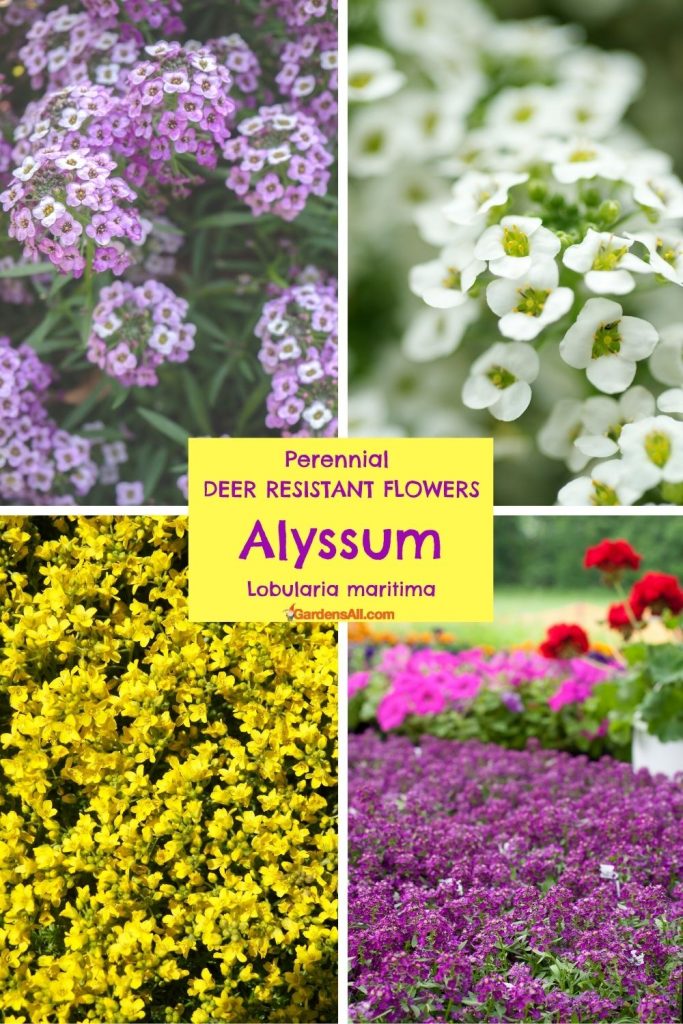
Alyssum, Lobularia Maritima, for Perennial Deer Resistant Flowers
Deer resistant perennials with flowers – Alyssum Lobularia maritima

Artemisia, for Perennial Deer Resistant Flowers

Common names for this plant include, mugwort (Artemisia vulgaris), or common wormwood (Artemisia absinthium), or sweet wormwood (Artemisia annua).

We have the silver mound artemisia (Artemisia schmidtiana) growing in our landscape for many years now. The only issue we’ve had with it is when there’s too much rain, it can get waterlogged, where some areas of the plant die off, however, it’s always recovered and bounced back.

Artemisia is the botanical name for a part of the daisy family. However, instead of blossoming into flowers like the daisy, Artemisia are more low-key and understated and make for great muted accent plants.

Often decked out in a silvery gray-green foliage, these plants are a beautiful, easy care addition to any garden or landscape area. Just be sure they’re in a well drained area for they don’t like excessive moisture.

The flowers that they do produce are small, and usually a muted purple or white in the late summer and early fall. These shrubs mature at one to five feet tall, and an impressive one to ten feet wide.

Artemisia is one of the lowest maintenance plants you can find. Not only is it deer and insect resistant and perennial, but it handles poor soil conditions, drought, and neglect surprisingly well.

They prefer dry to medium-dry soil, and neutral to alkaline soil pH values. Full sunshine or partial shade is fine and can be found in zones 3 – 10 in the US. Beware that some states list Artemisia as an invasive species, so do your due diligence before introducing it to your garden. In the wild, it is often referred to as white sagebrush.
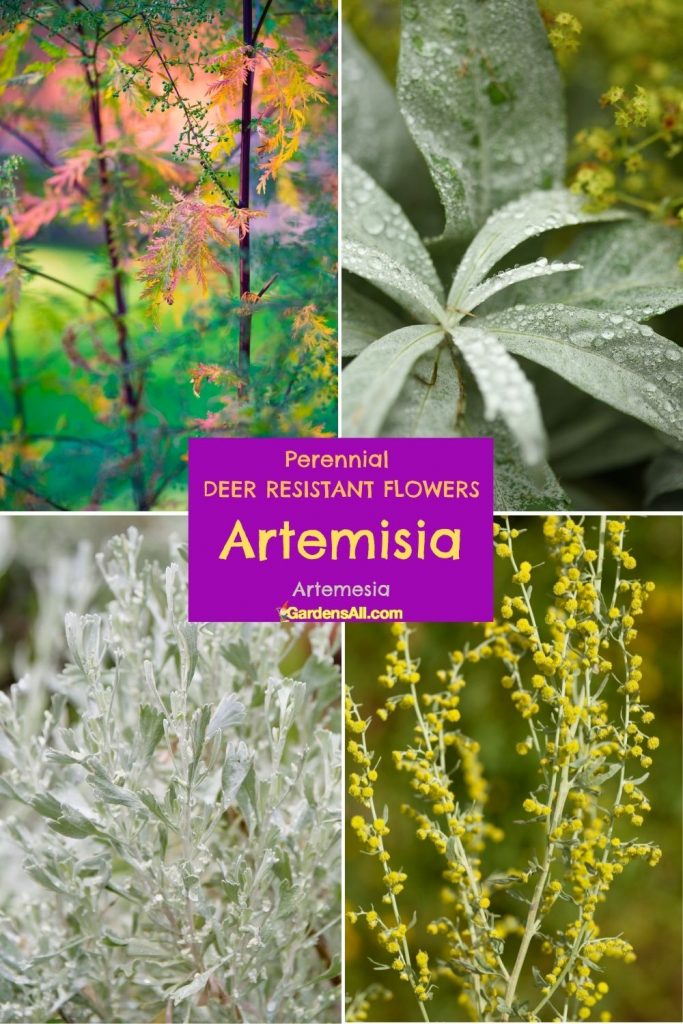
 - Artemisia is a perennial Deer Resistant Flower and plant
A Deer Resistant Perennial – Artemisia spp., a plant with many species, such as mugwort or wormwood

Bee Balm, Monarda spp., a Perennial Herb With Deer Resistant Flowers

Bee Balm is such a cute little flower that packs a lot of punch when it comes to vibrant red, purple, and pink colors and invites lots of good biodiversity to your space while still repelling deer. It is the ultimate cottage garden plant that is no fuss and highly self-sufficient.

The Bee balm uses and benefits are many. This unpretentious flowering plant does so much more than attract pollinators. It is also an edible herb, used for garnish, herbal teas and tinctures. It can be used to treat burns, rashes, skin irritants, and bee stings.

Monarda spp. grows fast, usually blooming in the first season, and produces many seeds every year, so it spreads aggressively. Songbirds, hummingbirds, bees, and butterflies will flock to it, and help pollinate the rest of your garden.

At full maturity, it stands at two to four feet tall, and blooms from late May to early September, again, depending on the growing zone. Its hardiness zones are 4 – 9, and it does best in rich, moist, acidic, or neutral soil in a sunny or partially sunny location.
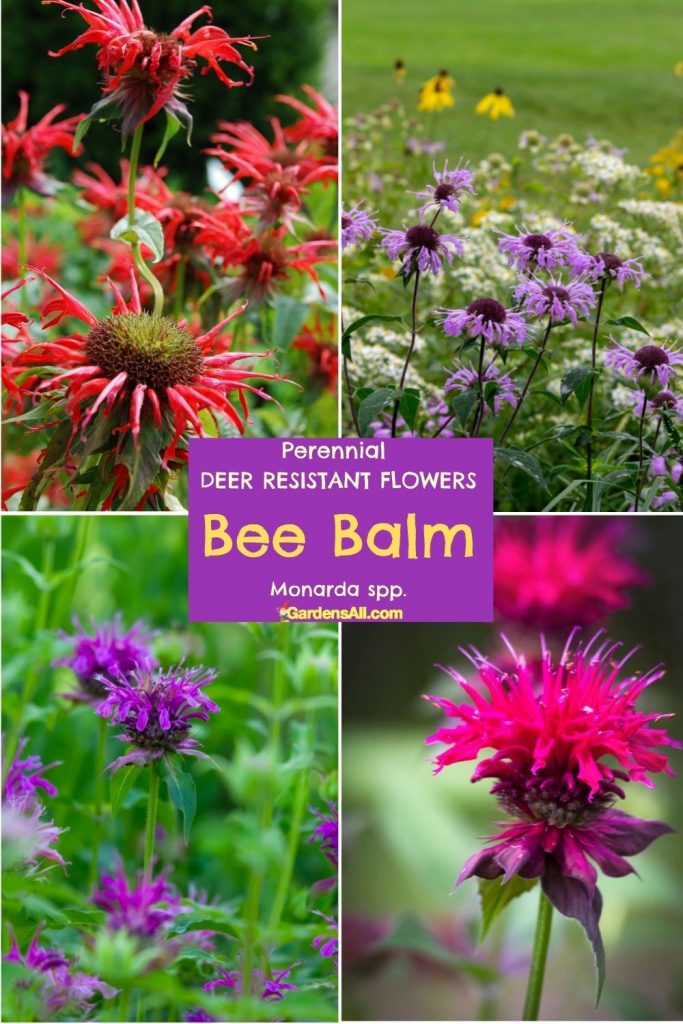
Bee Balm, Monarda spp., a Perennial Herb With Deer Resistant Flowers
Perennial deer resistant flowers – Bee Balm, Monarda spp.

Blazing Star, Liatris Spicata, for Perennial Deer Resistant Flowers

Liatris spicata is part of the Aster family, with beautiful feathery, long, bottle-brush shaped flowers that bloom from early summer to early fall. The leaves look similar to grass, and the flowers are usually a vibrant purple color but can be different shades of violet, pink, reddish-purple, and white. 

Blazing Star or Liatris, prefers medium moisture, well-draining soil with a pH from acidic to neutral. They do best in zones 3-9 and like full sun exposure. 

Blazing Star, Liatris spicata, is a perennial deer resistant flowering plant that's beautiful in landscapes.
Blazing Star, Liatris spicata, is a perennial deer resistant flowering flower that’s beautiful in landscapes.

Black-Eyed Susan, Rudbeckia Hirta, for Perennial Deer Resistant Flowers

Black-eyed Susans look like yellow daisies with black centers. These gorgeous, hardy flowers are native to the Midwestern states and abundantly grow in gardens, fields, ditches, and even quiet gravel parking lots.

These perennials are coated with scratchy, hairy leaves — thus the name “hirta”, meaning hairy. Reportedly, those fine hairs irritate deer, which is why they are deer-resistant.

Black-eyed Susans prefer full sunshine, and moist, mostly infertile, yet well-drained soil. They can handle acidic to neutral soil, and do best in hardiness zones 3-7. It survives droughts and high humidity quite well and produces dozens of blooms every year without fail.

Rudbeckia hirta matures at two to three feet tall, and blooms from late May through early September, depending on their zone.

Difference Between Black-eyed Susan and Brown-eyed Susan

While these two plants are almost identical, and both bear the same botanical name, there is a difference:

  • Black-eyed Susans are shorter, with larger, ~3 inch blossoms, and bloom earlier.
  • Brown-eyed Susans are taller with smaller, ~1.5 inch flowers, and bloom later.
Perennial deer resistant plants, black-eyed susan, Rudbeckia hirta

Bleeding Hearts / Common Bleeding Heart, Lamprocapnos Spectabilis

Lamprocapnos spectabilis produces unique, pillow-like blooms that are heart-shaped and delicately hung from a stem in a neat row. The heart-shaped, spring-blooming flowers are red, with a white and yellow petal dangling from the bottom of the heart-shaped flower. 

These delicate flowers grow to be six to thirty-six inches tall and likes partial shade to full sunshine, and rich and moist soils with a slightly acidic pH value. They are incredibly hardy when it comes to USDA zones, thriving in zones 2 to 10.

These beautiful bleeding heart plants grow wild in our woodland property.

For a longer blooming variety, the fringed bleeding heart blooms throughout the summer.

 Bleeding Hearts / Common Bleeding Heart, Lamprocapnos Spectabilis, is a perennial deer resistant flowering flower.
Bleeding heart, Lamprocapnos spectabilis, is a perennial deer resistant flowering flower.

Brown Eyed Susan, Rudbeckia Triloba, for Perennial Deer Resistant Flowers

Brown Eyed Susans are technically a biennial, meaning individual plants only live three years. However, they drop so many seeds and volunteer so easily that they require no care from you. In fact, these plants grow fast and spread quickly while producing tons of stunning flowers that are perfect for cut flower arrangements. If you don’t regularly maintain your garden, it will be invasive. 

Rudbeckia triloba, usually reaches three feet tall, though in the right conditions they can double this height. They like moist, well-drained, neutral to acidic soil in full sunshine. They have a hardiness zone of 3-7 and will tolerate more shade the warmer the climate is. It handles drought and humidity with ease.  

Brown-eyed susan-Rudbeckia triloba-a perennial deer resistant flower
Brown-eyed Susan, Rudbeckia hirta, is a perennial deer resistant flower.

Brunnera, Brunnera Macrophylla, for Perennial Deer Resistant Flowers

Brunnera macrophylla is an easy-to-grow, low-maintenance groundcover plant with bright blue flowers that resemble a forget-me-not. 

It grows to be twelve to eighteen inches tall, blooms in the spring, and tolerates shade to full sunshine, though shade is its preference. 

Brunnera grows in zones 3-8, and prefers medium moisture in organically rich acidic to alkaline soil that is also well-draining. 

perennial Deer Resistant Flower-Brunnera macrophylla-collage
Brunnera macrophylla is a perennial deer resistant flowering plant.

Butterfly Bush, Buddleia Davidii, for Perennial Deer Resistant Flowers

Buddleia davidii is a flowering shrub that attracts dozens of species of pollinators, especially butterfly varieties. The Butterfly bush can grow to be twelve feet tall, and have many shades of pink, purple, violet, blue, black, yellow, cream, and white. They bloom from June through September. 

These bushes do best in zones 5-9, with full sunshine in medium moisture and slightly acidic to neutral soil. They do not do well with too much or too little water, so it’s important that they are in well-draining soil, and receiving moisture regularly. 

Perennial Deer Resistant Flowers - Butterfly Bush, Buddleia davidii.
Deer Resistant Flowers – Butterfly Bush, Buddleia davidii.

Catnip, Nepeta Cataria, for Perennial Deer Resistant Flowers

Catnip, not to be confused with catmint, attracts cats and is used for teas, tinctures, and cat toys. Even though cats like catnip, it is toxic to them in high quantities.

Nepeta cataria produces flower spikes in the late summer and early fall and will bloom during its first season of growth. It grows to be two to three feet tall and wide and like sandy or loamy well-drained soil with a pH value that can be slightly acidic, slightly alkaline, or neutral. Full sun is necessary for it to thrive. It has a hardiness zone range of 3 – 7.

Catnip will self-pollinate and is effective at beckoning pollinators into your garden.

Learn more wonder reasons for growing catnip, good for people too!

Catnip, Nepeta Cataria, for Perennial Deer Resistant Flowers
Perennial deer resistant flowers – catnip, Nepeta cataria

Daffodil, Narcissus jonquilla, for Perennial Deer Resistant Flowers

Jonquils are sometimes called Easter lilies or daffodils, (depending on your part of the country). All jonquils are daffodils, but not all daffodils are jonquils.

Perennial bulbs, Jonquils grow to be about a foot tall and bloom around Easter in April and early May. The daffodil hardiness zone is 4-8, though I have seen them in areas above and below this range. 

Narcissus jonquilla likes medium moisture, neutral to acidic soil with good drainage. They prefer full sun but can tolerate shade with ease. They need a lot of water during their growing and blooming period, which, luckily, is usually naturally provided since they grow and bloom in early spring. 

Contribution From the Community

I’d also plant daffodils all along the base to repel deer, (see deer resistant flowers). The leaves & sap of daffodils contain raphides, which are needle-shaped calcium oxalate crystals that cut the tongues of critters. I’ve never seen any daffodils, blooms or leaves, eaten by any mammal.
~Kelly S. Bracken, retired, permaculture design certified

EDITOR’S NOTE: Kelly was speaking of the base of espalier fruit trees, however daffodils can be a great deer resistant flower for any location.

Daffodils or Jonquils are perennial deer resistant flowers, scientific name is narcissus jonquilla
Perennial deer resistant flowers narcissus jonquilla

Columbine, Aquilegia spp., for Perennial Deer Resistant Flowers

If you want to attract hummingbirds and repel deer, this is the flower for you. Columbines have unique, color-clashing blooms that are beautiful, long-lasting, and pleasantly scented. The flowers are usually one or more of the following colors: red, yellow, orange, white, pink, purple, violet, blue, and coral. 

Columbine blooms last about a month or more in the summer and produce several seeds after bolting. Seeds germinate in about a month and will readily spread around your garden. 

Aquilegia spp. matures at three feet tall and thrives in full or partial sunshine. They do best in zones 3-8 and like loamy, sandy, rocky soil that is neutral or slightly acidic. Well-drained soil is the key to success when it comes to Columbines. 

Columbine are Perennial deer resistant flowers - Columbine Aquilegia.
Perennial deer resistant flowers – Columbine Aquilegia.

Echinacea, for Perennial Deer Resistant Flowers

Coneflowers, also called Echinacea, are tough and adaptive additions to your garden that bring in bold colors, attractive prairie flowers, and lots of beneficial biodiversity to the rest of your garden.

The flowers look like giant daisies, and the center of them is filled with nectar and seeds. Bees, butterflies, songbirds, and hummingbirds love the plant, which will bring your garden to life. They have a fibrous root system, making it easy to weather almost any conditions.

At full maturity, which takes about two years, Echinacea stands two to five feet tall, and blooms for the entirety of the summer, usually from July through September, depending on its local USDA grow zone. The blooms can be red, pink, purple, coral, yellow, orange, pale green, or bicolor.

They prefer well-drained, neutral to acidic soil with partial to full sunshine, in zones 3-8.

Echinacea are Perennial Deer Resistant Flowers
Echinacea – perennial deer resistant flowers

Foxglove, Digitalis Purpurea, Stately, Beautiful and Deer Resistant

Digitalis purpurea is a perennial or biennial that acts as a perennial. Foxglove produces many seeds prolifically but does not bloom until its second season. At full maturity, it stands at two to five feet tall, and one to two feet wide.

Foxglove produces red, pink, purple, blue, white, yellow, and cream blooms that smell sweet, and bloom from late spring through the summer. It has a hardiness grow zone of 4-10, and prefers soil that is slightly acidic, well-draining, and loamy. It is best to plant Foxglove in full sunshine, though it still handles partial sunshine quite well.

While Foxglove is deer resistant, it is not completely hands off. It is prone to suffering from crown rot, so excessively clay-like or constantly soggy soils should be avoided.

It can also get fungal diseases if it is exposed to humidity and moisture for too long, so keep an eye on that. Good air circulation around the plant is best practice for helping to prevent most issues with foxglove.

Foxglove-Digitalis, Perennial Deer Resistant Flowers
Foxglove – Perennial Deer Resistant Flowers

Iris, Iris Germanica, for Perennial Deer Resistant Flowers

Iris germanica is a gorgeous, low-maintenance plant that thrives in many conditions. They have sword-like leaves, spreading and/or drooping lobe flowers, and they grow from bulbs or rhizomes. Usually, they are classified as crested, bearded, or beardless. 

Mature at twelve to forty inches tall, the Iris bulb varieties will bloom in their first year. Depending on the variety and geographic region, irises can bloom from early spring to mid summer. Iris blossoms can be white, pink, purple, violet, blue, yellow, orange, red, or a combination of any of these shades. 

Irises have a hardiness zone of 3-9, preferring full sunshine and well-draining, slightly acidic to slightly alkaline soil. 

Deer resistant flowers - Perennial Iris, Iris germanica
Deer resistant flowers – Perennial Iris germanica

Lamb’s Ear, Stachys Byzantina, a Beneficial Plant That Deer Avoid

This unique plant is easy to identify and is an attractive addition to any garden. It has soft, fluffy leaves that are silvery green and will occasionally grow purple flowers. 

Stachys byzantina prefers full sunshine in zones 4-9, and likes well-draining, slightly acidic soil. If you live in a cooler climate, give it full sunshine. If you are in a warmer area, partial shade is best. 

Lamb’s Ear is tough and thrives in rocky, sandy soil that usually has poor soil content. It needs zero attention after being planted. 

Lamb's Ear, Stachys byzantina, is a deer resistant plant.
Lamb’s Ear, Stachys byzantina, is a deer resistant plant.

Larkspur, Delphinium Flowers are Resistant to Deer and Other Critters

Larkspur belongs to the buttercup family, which becomes evident when you can smell these deliciously sweet flowers. They are short-lived, but resistant to deer, rabbits, and groundhogs, which is quite a feat. Hummingbirds and butterflies are attracted to Larkspur flowers, which is another reason these may be a perfect addition to your outdoor space.

Delphinium can grow to be six or seven feet tall and produce white, yellow, blue, red, pink, or purple flowers. They prefer full sunshine, and do best in soil that drains well but is regularly watered. They prefer neutral to slightly acidic soil, too. USDA zones 3 – 8 are ideal, though a few varieties and hybrids can venture outside of this range.

RELATED: How to get rid of keep squirrels, rabbits, and rodents out of the garden.

Larkspur, Delphinium, for Perennial Deer Resistant Flowers

Lavender, Lavendula spp., for a Popular and Useful Plant That Deer Will Avoid

Lavender, or Lavendula spp. is a fragrant herb and flower that grows to be two to three feet tall, and produces gorgeous upright purple flower spikes. 

Wonderful for fragrant summer long blooms, lavender grows best in zones 4-9 in dry, well-draining soil that is alkaline. They prefer full sun but will tolerate limited amounts of shade during the day. Humid or exceptionally wet summers can kill lavender, so it’s best to plant them in dry areas. 

You may enjoy this article on growing lavender and making lavender oil.

Lavender, Lavendula, is a deer resistant plant.

Lupine, Lupinus, for Perennial Deer Resistant Flowers

Lupinus is a beautiful three to four-foot-tall plant that is native to the Pacific Northwest and the western United States. It is one of the few plants that are truly poisonous to deer. In fact, Lupine is so toxic, it has been known to cause death, miscarriage, and birth defects in cattle, sheep, horses, pigs, and deer. 

Lupines come in many colors and varieties. In the wild, you’ll primarily find Silvery Lupine, which has silvery green leaves and blue to purple branched caudex flowers. If you opt for a non-native species, such as Russell Hybrids, the spike flowers are much more colorful, with reds, pinks, yellows, blues, purples, oranges, and creams. They can also be bicolor. Depending on the variety you select, and your zone, they should bloom from late May through early August. 

Lupine can grow in US hardiness zones 3-8. They prefer neutral to acidic, organically rich, sharp-draining soil in full sunlight in cooler climates. They are deer, disease, and pest resistant, with the wilder species fairing better than the cultivated versions.

poisonous to Deer-Lupine-Lupinus
Perennial deer resistant flowers – Lupine, Lupinus

Peony, Paeonia Officinalis, Lovely Full Blossoms Good for Cut Flowers

A favorite garden plant with beautiful large blossoms is Peony, Paeonia Officinalis, that deer tend to avoid.

Peonies are a late spring flower that produce gorgeous blooms that range from two to twelve inches in diameter. They come in many shades of pink, red, rose, coral, purple, cream, and white, and bloom from late spring to late summer, the colder your area, the later in the summer they will flower. 

Peonies grow in zones 3-9; they prefer well-draining, slightly acidic soil in full sunshine. Tree varieties will prefer more alkaline in their soil. Harsh winters and cooler summers are their preferred climate. 

Paeonia Officinalis-perennial Deer resistant-flowers
Perennial deer resistant flowers – Peony, Paeonia Officinalis

Poppy, Eschscholzia, for Perennial Deer Resistant Flowers

Eschscholzia comes in many species, varieties, and colors, and grows vigorously as it is a perennial that prolifically produces many seeds each year. Poppy seeds can lie dormant for a hundred years and still germinate with a high rate of survival.

Most bloom in early summer, though some varieties bloom in spring, while others wait until later in the summer; Most grow to be about 18 to 48 inches tall, but the Matilija Poppy can be up to nine feet tall.

Poppy blooms are orange, yellow, red, pink, purple, cream, or white. The most popular varieties are California Poppy (Eschscholzia Californica), Oriental Poppy (Papaver Orientale), Common Poppy (Papaver rhoeas), Himalayan Blue Poppy (Meconopsis betonicifolia), and Matilija Poppy (Romneya coulteri)

Poppies prefer neutral to acidic sandy soil in zones 1-10 (depending on their variety) and do their best in full sunshine. 

Poppy, Eschscholzia, for Perennial Deer Resistant Flowers

Rose Campion, Lychnis coronaria, for Perennial Deer Resistant Flowers

Lychnis coronaria is considered by some to be a short-life perennial, and a biennial to others. It prolifically produces seeds and grows new plants very quickly, so either way, it acts like a perennial that you won’t have to put any effort into keeping alive.

Rose Campion can spread relatively quickly too, but if you’re like me, you won’t mind because it is so self-sufficient and beautiful. Rose Campion blooms bright purple to magenta flowers in May, and the blooms will last through August. The foliage is similar to Lamb’s Ear, and the entire plant stands at about three feet tall.

It can withstand drought, insects, deer, and many other smaller animals, including rabbits and squirrels.

Rose Campion prefers well-draining soil that is watered on a regular basis. It also prefers full sun, and zones 4 – 8. It prefers poor soil quality and wants neutral to alkaline soil pH values.

Rose Campion, Lychnis coronaria - Perennial Deer Resistant Flowers
Rose Campion, Lychnis coronaria – Perennial Deer Resistant Flowers

Sage, Salvia Officinalis, for Perennial Deer Resistant Flowers

This perennial, evergreen “subshrub”, Salvia Officinalis has pretty, aromatic foliage that can be used for cooking. Sage leaves are slightly peppery and can be added to dishes fresh, dried, or freeze-dried. Sage produces long-lasting blueish-purple spike flowers in the summer. 

This herb can grow to be 30 inches tall and does best in loamy, sandy, rocky, well-draining soil with a neutral to acidic pH. You can grow it in zones 4-10, and it prefers full sunshine in all zones. 

Sage, Salvia Officinalis, for Perennial Deer Resistant Flowers
Sage, Salvia, is a perennial deer resistant plant

Plant Enough to Share

As we mentioned earlier, we love wildlife. Each winter we feed the birds and squirrels, and the hummingbirds in spring through fall. (See hummingbird feeders and hummingbird food recipe). We Also feed the wildlife by throwing scraps out as far as we can from our deck (so as not to attract them closer by).

However, most scraps go into our organic compost, (see best compost tumblers). So beyond that, we also plan to keep on planting plants that deer enjoy on the outlying perimeters of our land so they’ll have food options around — but not in — our yard.

Perennial deer resistant flowers definitely provide the best return on your investment, and they keep coming back year after year, with little to no care. Not only do the deer tend to avoid them, these perennial deer resistant plants also help deter deer from eating the other non-deer resistant plants nearby.

To plan accordingly is to create a biointensive gardening ecosystem that sustains you and your family as well as the natural ecosystem of your yard and beyond.

The good news is that what’s best for your yard and garden is also what’s best for the planet, so it’s a win-win❣️

OH! And here’s another bonus: many of the deer resistant flowers are also mosquito repellent plants as well as for other pests❣️👏🏼😇🌎☀️

388Shares

FDA Compliance

The information on this website has not been evaluated by the Food & Drug Administration or any other medical body. We do not aim to diagnose, treat, cure or prevent any illness or disease. Information is shared for educational purposes only. You must consult your doctor before acting on any content on this website, especially if you are pregnant, nursing, taking medication, or have a medical condition.

Affiliate Disclosure

GardensAll.com is a participant in the Amazon Services LLC Associates Program, an affiliate advertising program designed to provide a means for sites to earn advertising fees by advertising and linking to Amazon.com. Pages on this site may include affiliate links to Amazon and its affiliate sites on which the owner of this website will make a referral commission.

Want to submit your photos, videos and/or article content for publication? We love to share! growers@gardensall.com